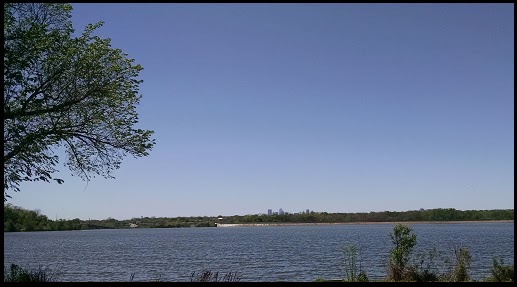
Rebekah and I didn’t actually mean to tour Lake
Highlands. We were off to see the Dallas Arboretum, but bad weather had
disrupted the park causing an unexpected closure. So instead of our planned
outing, we took a drive around the area and did a bit of shopping. Lake
Highlands, the neighborhood around the Arboretum, extends north to Richardson,
east to Garland, south to White Rock Lake and East Dallas, and west to Lakewood
and North Dallas. Most of the area is populated with historic homes and older
places of business.
One of the nice things about living where we do
is that there is always a new restaurant springing up. This post reviews four
places we’d not tried, one that changed management, and three that we visited
previously. For information on my rating
scheme, take a look at Reading the
Reviews. To get some information on the towns you’ll find these eateries
in, click on the links that will lead you to previous blogs.
t’s all about the food – or at least good food
makes a trip better. We did have several nice meals made even better with a
group of new friends. I’m a bit spoiled; even though I have food allergies that
make getting common items sometimes a bit difficult, chefs and cooks generally
do their best to accommodate me. On this trip if I ordered on my own I could
talk to the wait staff and find something that was local but acceptable to my
dietary needs. When I was with the group, I got grilled or roasted chicken at
each meal; this was disappointing. Again, to see how my rating system works,
take a look at Reading the Reviews.
This was an
interesting trip. Barb and I booked it with the idea that we’d see some places
we’d never been, get in some good bead shopping, and have some beading time. As
with any trip, there were some things we really liked, and some we weren’t too
happy about. Also, our perceptions of the trip didn’t necessarily match those
of other travelers. For instance, we really liked our first local guide,
Blanca. She had a wealth of knowledge and filled the air with information. Our
expectations for group behavior seemed to be the same as Blanca’s: keep up, ask
questions, pay attention, and realize that the local guide wasn’t there to
service just one person. Blanca did far better with some of the folks in our
group than I did; I’d have sent them home on day one. Since this is a
very long blog, it’s divided into two parts. This one covers Where We Stayed and What We Did; What We Ate is in the second post. In previous blog posts I've written about many of the things we did, so rather than rehash those experiences, I've given you links back to the specific pages. To see how my rating system
works, take a look at Reading the Reviews.
Each morning on the Danube was beautiful, but this day was
special. We were awakened to a wonderful view of the House of Parliament
with the rising sun’s rays on it. Although it was close on to 5:00AM, it was
hard to go back to sleep with the stunning scenery sliding by. Budapest was
officially created by merging Pest, Buda and Óbuda in 1873. But back in the
first century BC the Celts built the first town that would become a portion of
Budapest. This was a densely populated settlement with potteries and bronze
foundries, and perhaps a trading center. Romans colonized an area immediately
west of the Danube, using the natural thermal springs; the new baths in
Budapest reminded me of those in Karlovy
Vary in Czech Republic. By 106 AD the city had become the
Exterior of a bath house
capital of the
province Pannonia Inferior and the headquarters of the governor and a significant
military force. Of course this means that it was frequently involved in wars
along the Danube. A parade of conquerors made the city their headquarters from
the 5th century AD through the Middle Ages. Buda and Pest
started their development in the 12th century because the French,
Walloon, and German settlers worked and traded under royal protection along the
Danube. The history of Hungary followed the path of Czech Republic, Slovakia,
and Austria with prosperity, and the flourishing of the arts followed by wars
and destruction; in some instances Buda was a leading in others Pest was
preeminent.